


Yinka Shonibare CBE
Wind Sculpture (SG) II
2021
Read more
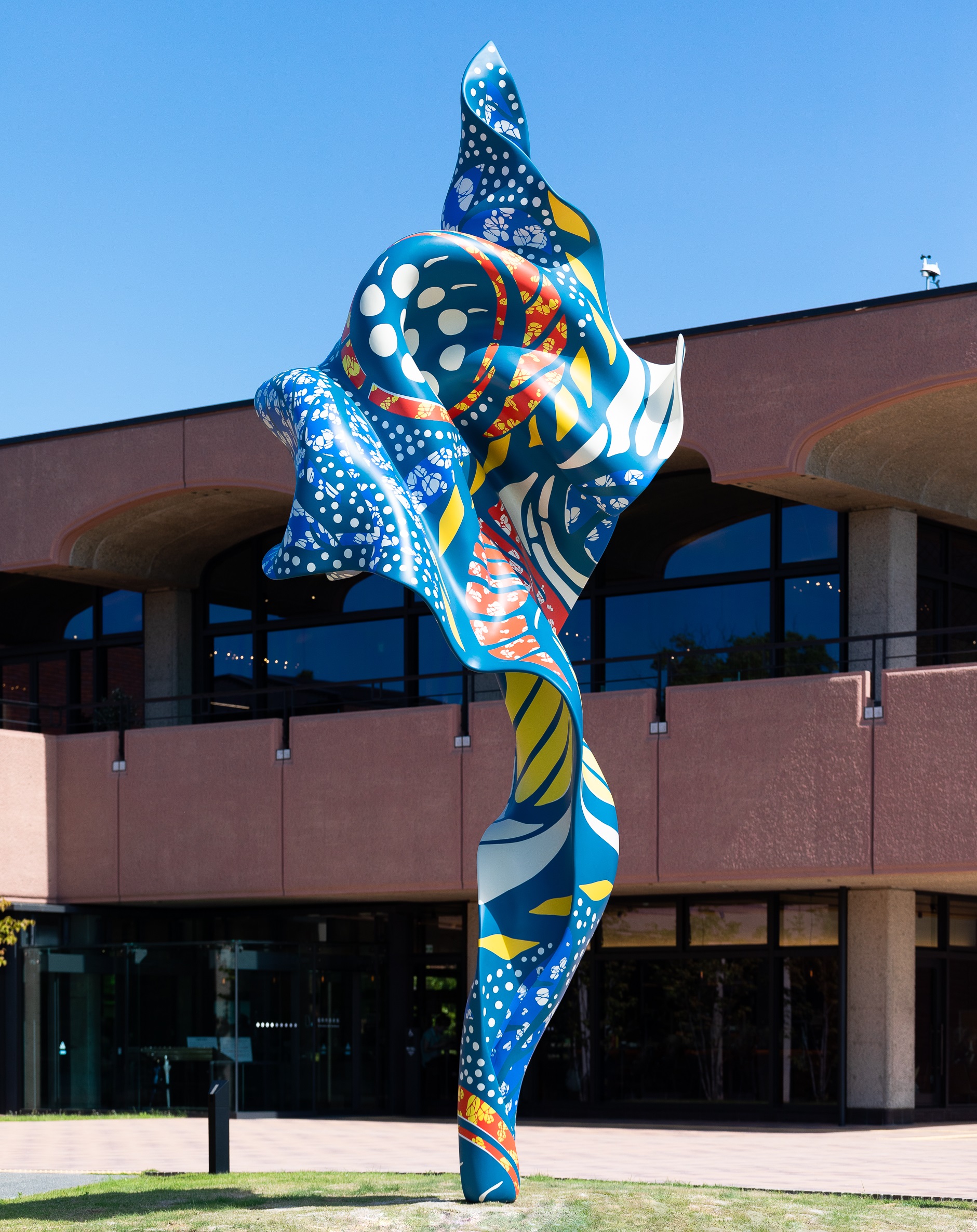
© Yinka Shonibare CBE, 2021. Courtesy of James Cohan Gallery, New York
Photo: Shintaro Yamanaka (Qsyum!)
2021 Glass reinforced polyester resin, acrylic paint, steel
700.0cm×250.0cm×200.0cm
b. 1962, British-Nigerian
Shonibare employs textiles known as “African prints” to create works that compellingly subvert social structures continuously in place since the colonial era. “African prints” are printed cotton textiles, featuring vibrant colors and striking patterns, which are still commonly used to produce clothing today. Despite the name, these textiles do not originate in Africa but in the Netherlands and Britain, which manufactured printed fabrics modeled on Indonesian batik for export to their colonies, and subsequently exported them to Africa where they became part of the culture. Shonibare has focused on these textiles as embodiments of complex and diverse cultural hybridization.
Wind Sculptures is a series of large outdoor sculptures Shonibare has been producing since around 2013. They take on intricate, undulating forms, resembling fabric catching the wind like the sails of a ship. Actually making fabric stand upright is impossible, but in this sculpture he realizes a form that appears to defy gravity, and combines pliable resilience with unyielding tenacity.
The pattern in this work is based on Super Wax Print with Botanical Pattern (1993), a Japan-made “African print” in the collection of the Fukuoka Art Museum.
Wind Sculpture (SG) II is a work that highlights the history and future of multicultural exchange across oceans, by which Japan, other Asian nations, Europe, and Africa are interconnected.
2021
Read more
1950
Read more
Japan, Edo Period, 17th century
Read more
1963
Read more
Japan, Heian Period, 12th century
Read more
1994
Read more
China, 15-16th century
Read more
1934
Read more
1931
Read more
1945
Read more
1964
Read more
1910
Read more
1945
Read more
Edo Period, 19th century
Read more
Edo Period, 18th century
Read more
India, 17-18th century
Read more