


Yinka Shonibare CBE
Wind Sculpture (SG) II
2021
Read more
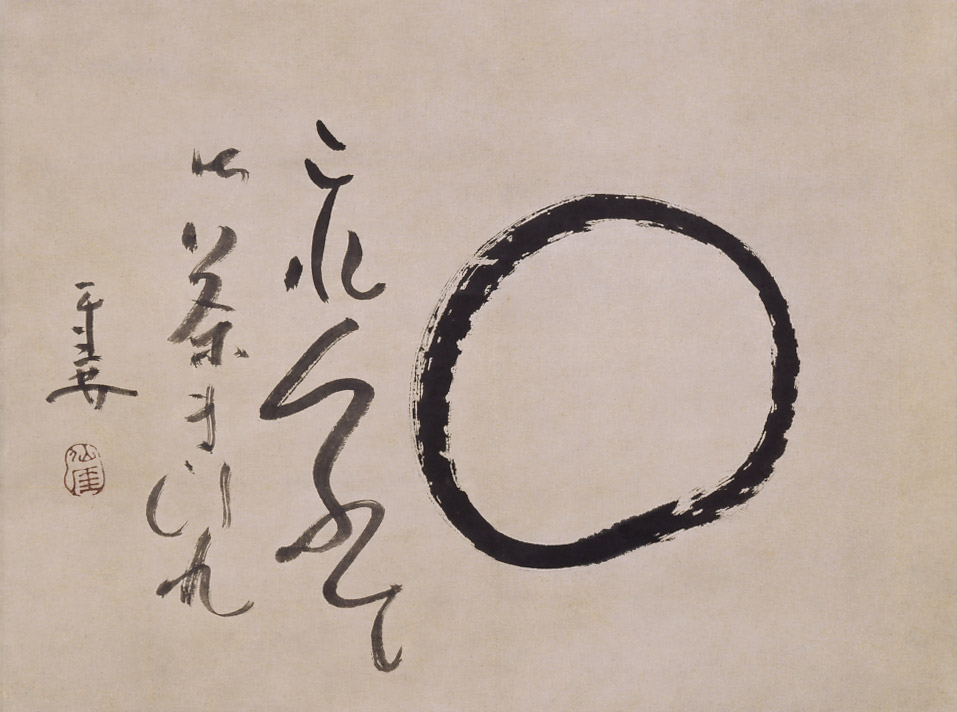
Edo Period, 19th century Ink on paper, hanging scroll
37.0cm x 49.4cm
Ishimura Collection
1750 – 1837
Sengai Gibon (1750-1837) was a chief priest of the first Zen temple in Japan, Shofukuji. He was born in Mino Province (present-day Gifu Prefecture) and came to Hakata at the age of 39, spending the rest of his life in the area. His paintings freely drawn with black sumi ink were highly popular, with a highly approachable appeal, yet concealing various life secrets and lessons.
This work features a simple ink circle and the inscription “Eat this, and have some tea.” With its plump lower half, this circle may remind viewers of a sweet manju cake or a baked rice cake. The artist shows his sense of humor with his literal “painted image of rice cake” (a Japanese expression equivalent to “pie in the sky”).
On the other hand, those who know the true meaning of this circle may see it differently, as circles are drawn by Zen monks to show their state of enlightenment. Sengai shocks with the bold move of treating a symbol of enlightenment as something as light as a teacake, and the person who received the painting must have been taken aback. The more Zen knowledge one has, the less one can laugh it off.
Various interpretations are conceivable according to viewers’ vantage point and knowledge. This is both a work of art and a Zen teaching, brimming with the characteristic appeal of Sengai’s work.
2021
Read more
1950
Read more
Japan, Edo Period, 17th century
Read more
1963
Read more
Japan, Heian Period, 12th century
Read more
1994
Read more
China, 15-16th century
Read more
1934
Read more
1931
Read more
1945
Read more
1964
Read more
1910
Read more
1945
Read more
Edo Period, 19th century
Read more
Edo Period, 18th century
Read more
India, 17-18th century
Read more