


Yinka Shonibare CBE
Wind Sculpture (SG) II
2021
Read more
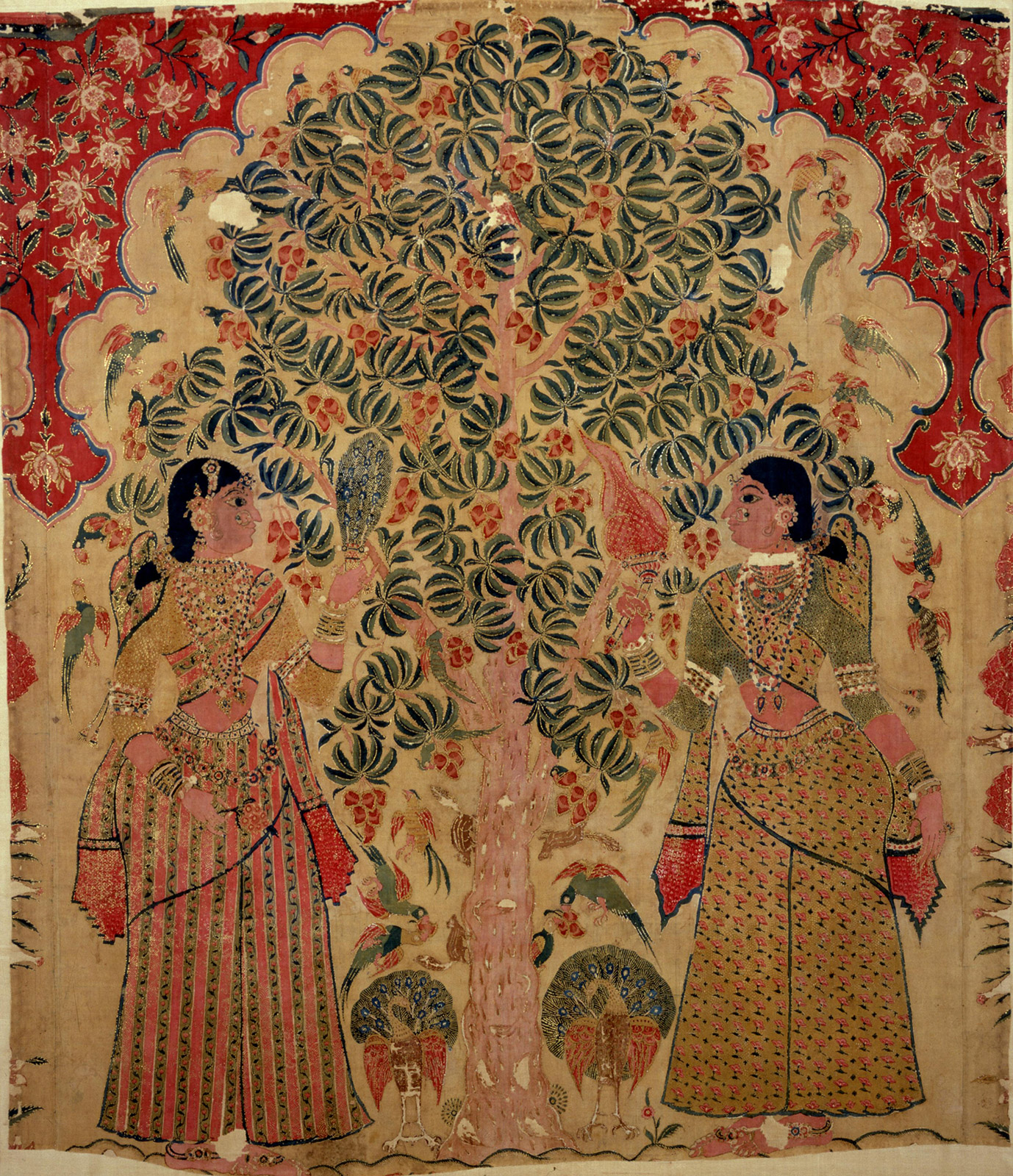
India, 17-18th century Resist-dyed and mordant-dyed cotton
128.5cm x 110.8cm
Sarasa, akin to calico, has been known since ancient times for its brilliant colors and praised around the world for its colorfastness. Many varieties of sarasa have been produced in accordance with the demand of importers. This type is thought to have been made for domestic use for wall hangings at religious institutions. In addition to the vivid colors of the dyes, thick gold paint increases its splendor.
Two women stand face-to-face under a tree heavy with mangos. One holds a fan of peacock feathers and flowers, while the other one holds a ritual implement in the shape of a brush. From the objects they hold, they are thought to be Gopi, or female cowherds, waiting for the manifestation of the deity Krishna as an incarnation of Vishnu. Although Krishna is not depicted, a mango tree is thought to indicate Krishna’s presence indirectly, as is a story involving Krishna’s hiding in a tree with a Gopi’s sari. Peacocks, birds and small animals like squirrels can also be seen around the leafy tree. Looking closely, we see many of these small animals are in pairs. The whole image is full of happiness befitting a symbolic representation of Krishna, the god of love.
2021
Read more
1950
Read more
Japan, Edo Period, 17th century
Read more
1963
Read more
Japan, Heian Period, 12th century
Read more
1994
Read more
China, 15-16th century
Read more
1934
Read more
1931
Read more
1945
Read more
1964
Read more
1910
Read more
1945
Read more
Edo Period, 19th century
Read more
Edo Period, 18th century
Read more
India, 17-18th century
Read more